Using Cemeteries in Your Research
You know you are a devoted family researcher when the thought of going to a cemetery excites you! There can be a treasure trove of information in the cemetery office and on the headstones themselves. But you’ll never know what is there if you don’t look for yourself. It is like any other source you come across. You cannot just take someone else’s word for it – you need to check it out yourself.
So, where exactly do you start looking for burial information? As always, start with what you know already. Do you know where someone is buried already? Do you have a family story that says where someone is buried? Or maybe you have no idea where they are buried, but at least you may know where they lived (and perhaps died too). Religion can play a role in where someone is buried too. There are non-denominational cemeteries as well as Jewish, Catholic, and ethnic ones.
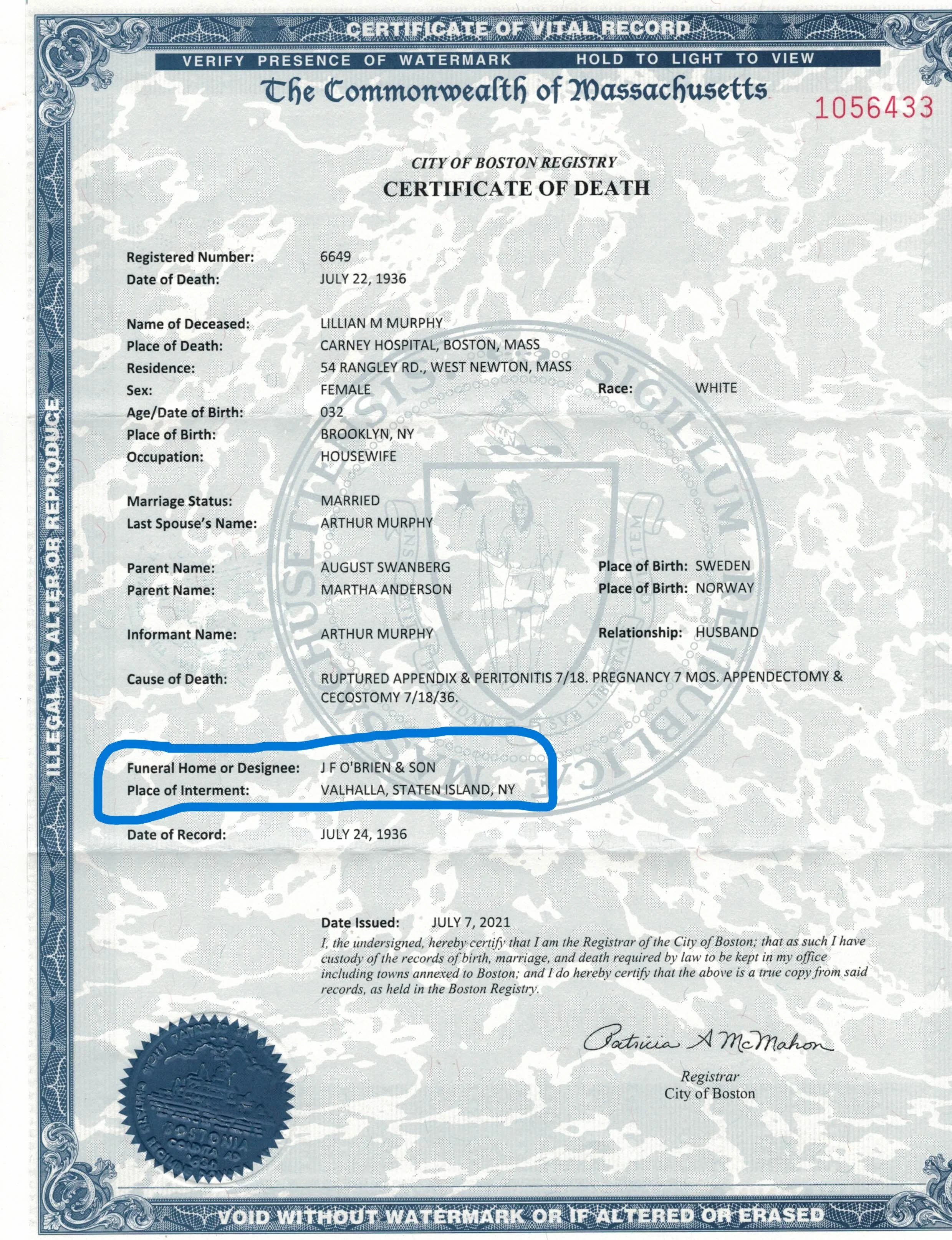
The first step is to see if you have information already that tells you where someone is buried. You may have already visited the gravesite; a family member may know where the family is buried; and the best one – look on the death certificate for the burial location. This shows my great aunt being buried in Valhalla in Staten Island NY.
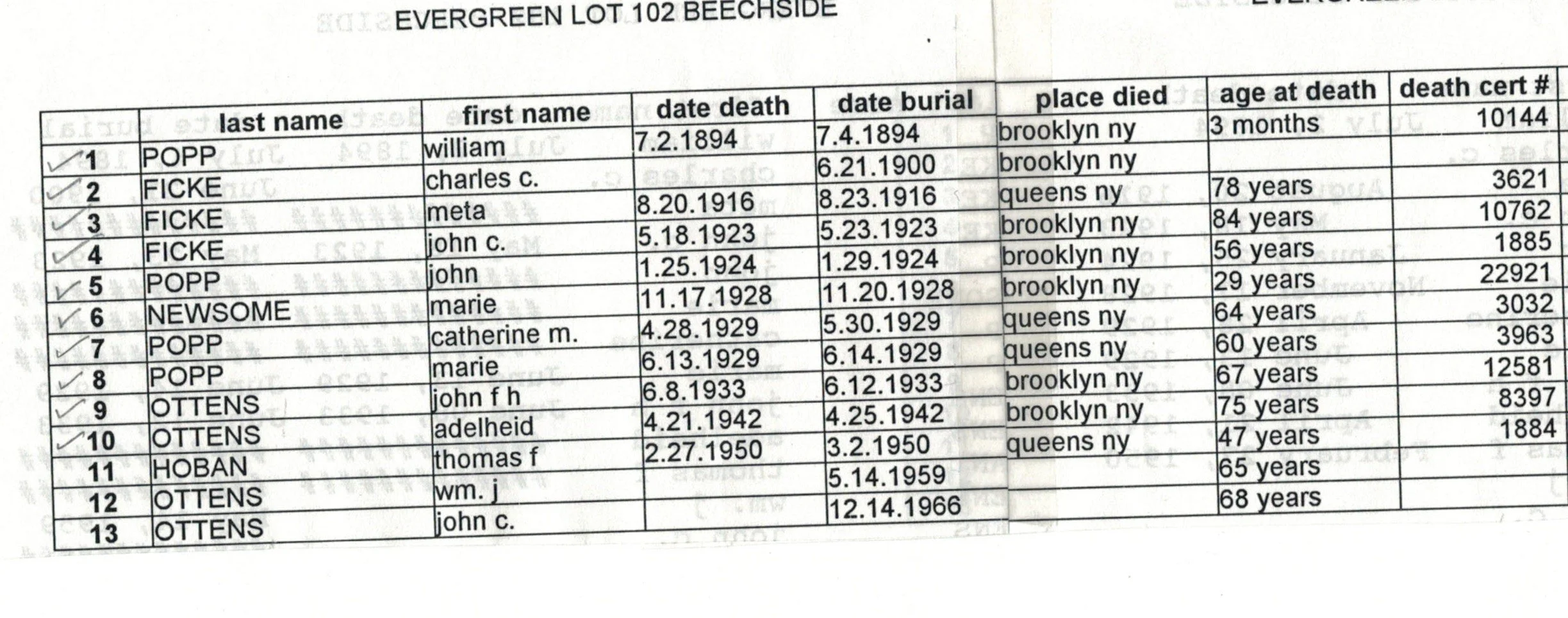
Once you have collected that information, start writing down who are buried in what cemeteries. It does not have to be a fancy chart; just a simple listing will work fine. You can start to build it out with dates of birth and death if you have them (if not, you hopefully find them soon!). As you can see in the example below, I made a table in Microsoft Excel, and I just kept adding information as I found it. In this case, I had found the place of burial for my great grandmother, Meta Ficke. The list grew to this as I found out more information. I’ll explain about that as we go along.
Great! Now you are gathering information, but you may be missing a lot of information, such as other relatives or older burials. That is where the next steps come in handy. Not everything is on the internet, but there is a lot that can possibly help you. There are websites such as Find A Grave (https://www.findagrave.com/ ) and Billion Graves (https://billiongraves.com/ ) that you may have heard of or already use. Find A Grave is free; Billion Graves is free, but you need a subscription to be able to see everything.
Find a Grave allows you to make Virtual Cemeteries, which means you can set up “cemeteries” by family name, by cemetery, by state, and by any other way you want. And you can put people in multiple “cemeteries.” Personally, I have my virtual cemeteries set up by family name and cemeteries. So Meta Ficke is in Ficke, Kattenhorn (her maiden name), and Evergreen Cemetery. I can easily see who is buried in Evergreen (all the people listed above, and a few more) should I want to visit gravesites and take photos. The family “cemeteries” allows me to find an entire line of family and where they are all buried.
One way I use Find A Grave is to search by family name and where they lived, or by cemetery if I think I might know where they are buried. It allows me to try to find someone’s burial information when I don’t know when or where they are buried.
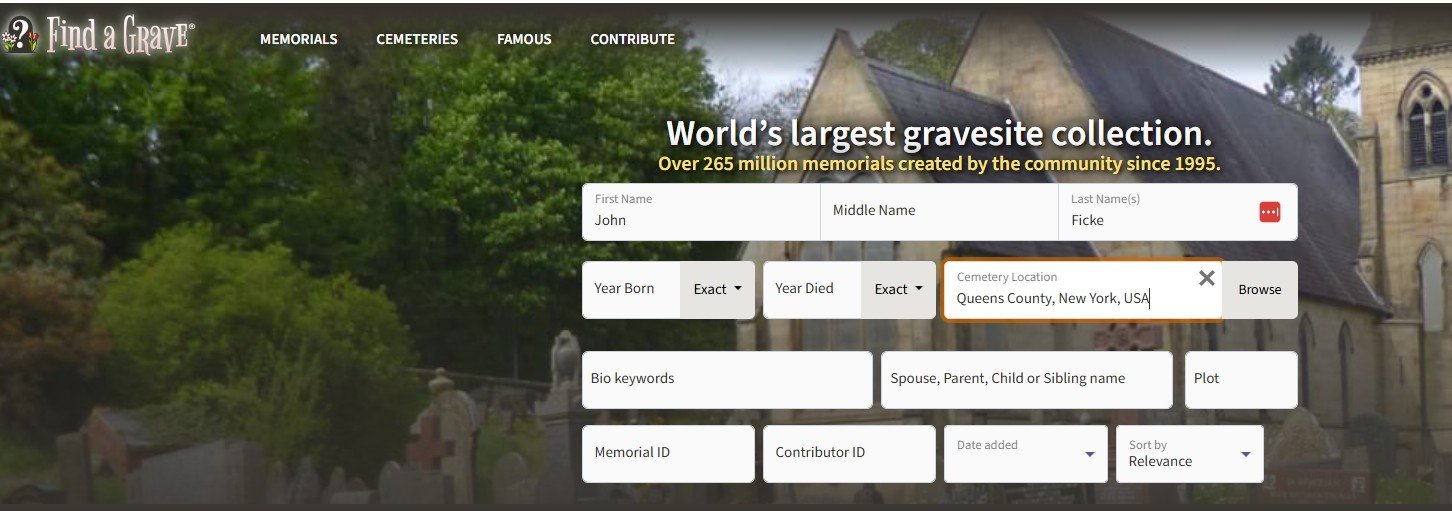
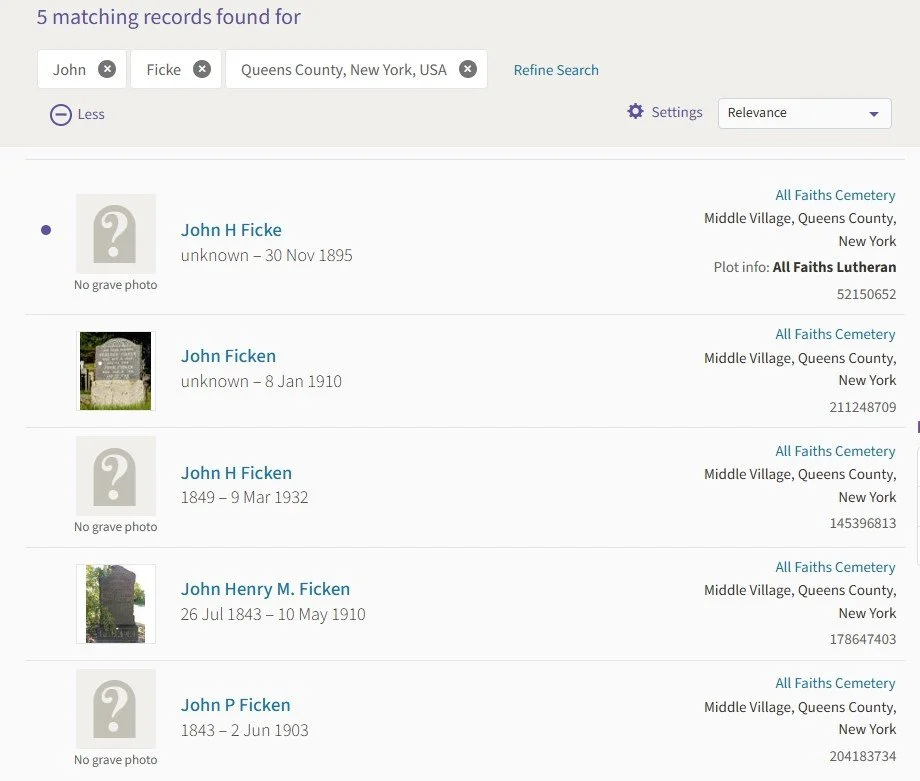
The best way to learn to use Find A Grave is to play around with it using someone who you know where they are buried. But you may not find who you are looking for, even if you know where they are buried. Why, you ask? Easy, no one may have made a memorial for the person you are looking for. Both Find A Grave and Billion Graves rely on people inputting burial information to build out their databases. That means you can create memorials for family members (or anyone for that matter) that are not listed on the site you are using.
What do you do if you don’t know any information and can’t find your person on either of these sites? Well, there are a lot of other sites you can go to. All the major genealogy sites have death and/or burial information. Just do a search in the catalog to see what they offer for the places you are searching in. You might just find the burial information there.
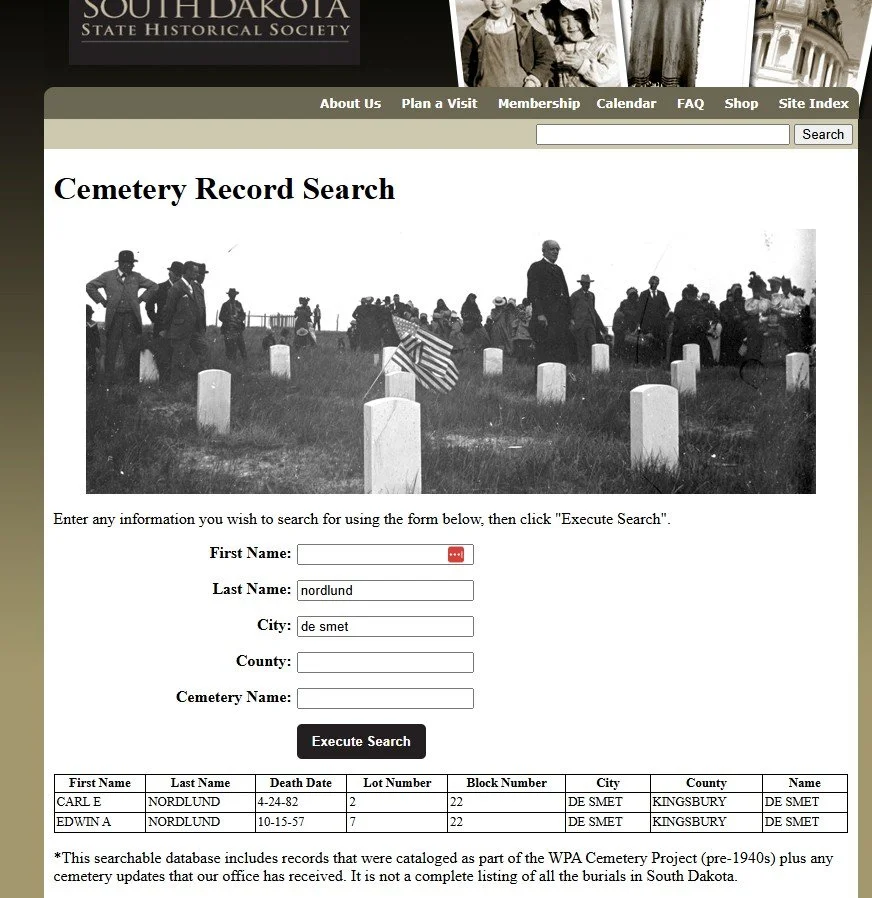
What I like to do is a Google search of the area in which I am interested. Here, I searched “cemetery records in De Smet SD” and produced hits for Find A Grave specific to De Smet, burials specific to Laura Ingalls Wilder (yes, that Laura Ingalls Wilder from Little House on the Prairie), and a state website that has burials for the state. If I never looked, I would have never known that the South Dakota government has burials listed!
If your relative was in the military, he or she could be listed on the Locate a Grave on the VA website (https://www.cem.va.gov/nationwide-gravesite-locator/ ). In order to be listed on the site, your relative must have been buried in a military cemetery. It also lists the family of the veteran, should they be buried with them. A search for Pukey in Long Island National Cemetery gave me this result:
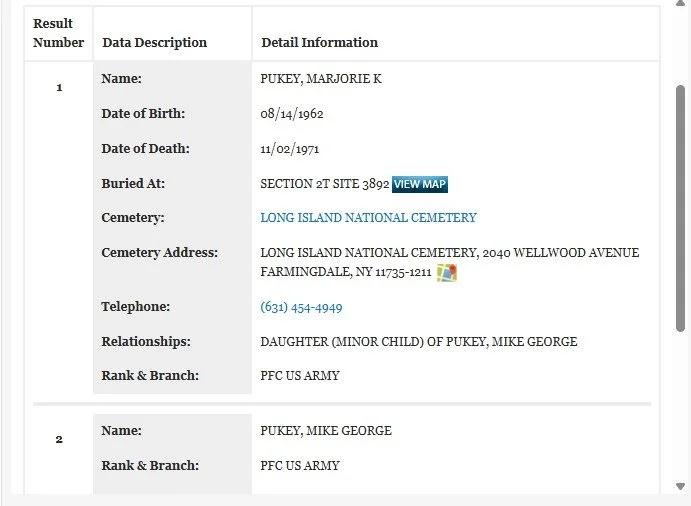
From prior research, I knew that Mike Pukey was buried in this cemetery. His daughter had died young, but I had no idea where she was buried. This search showed me that she was buried where her father was ultimately laid to rest.
If your family were buried in a Catholic Cemetery, you can look at the Locate a Loved One for them. You would need to do a search for “Catholic Charities Locate a Loved One” and include the state and cemetery name, if known. Not all Catholic cemeteries are online, but I have found an awful lot are.
If your family were buried in a Jewish cemetery, you can just do a search for burials using “Jewish burial locator” with the state. If you know the cemetery, you can use that in the search query too. Jewish Gen (https://www.jewishgen.org/databases/cemetery/ ) has over 7 million burial records from all over the world.
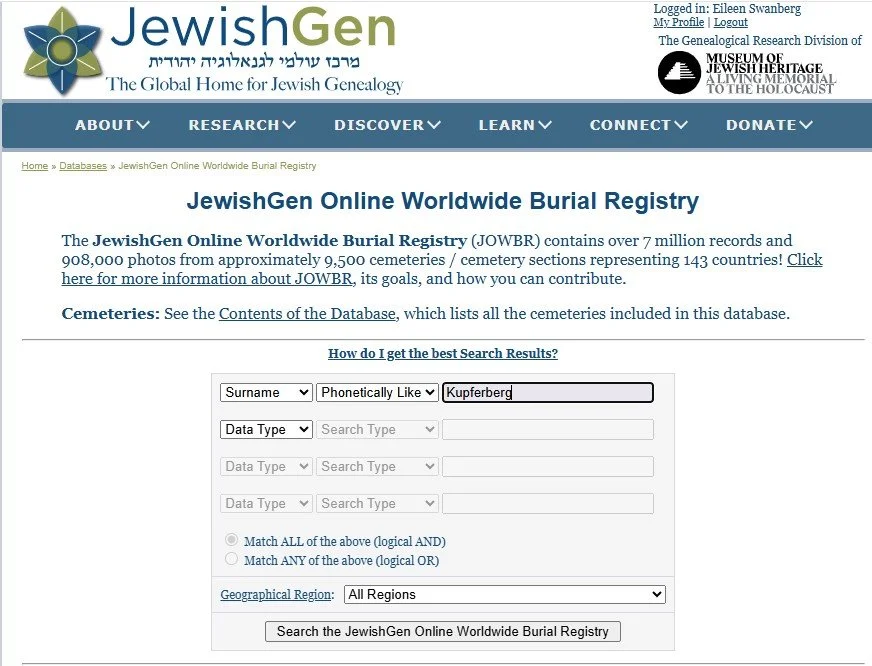
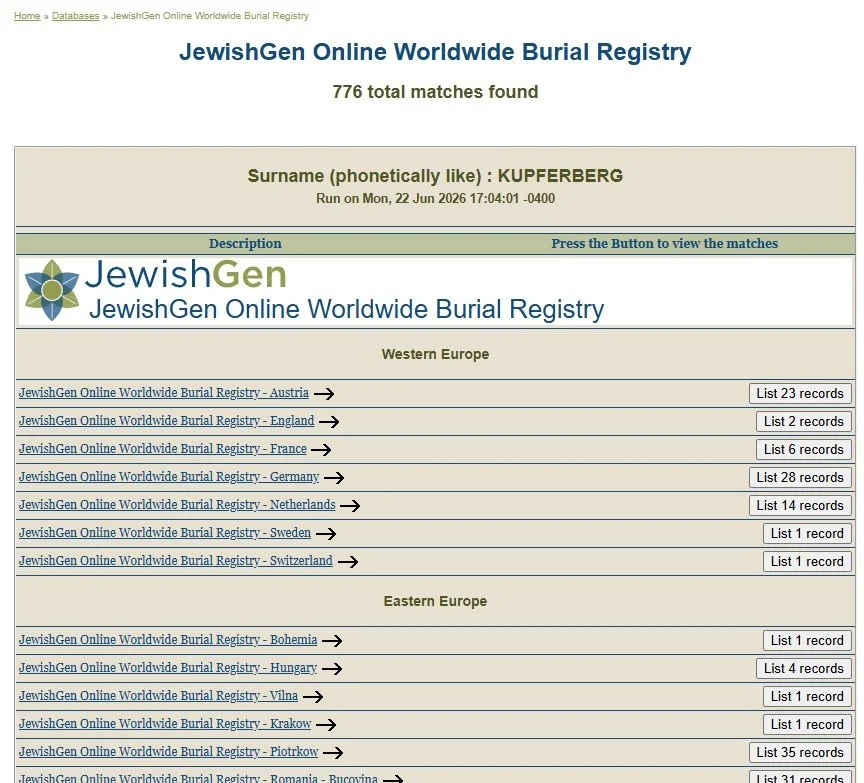
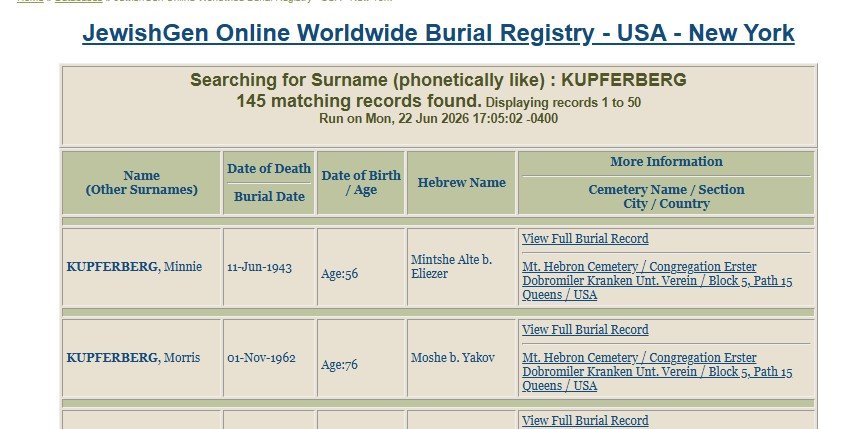
Scrolling down to USA, NY, I clicked on the box and saw the 145 results.
Another great place to look is to search the state, county, city, or cemetery name followed by “locator”. So many cemeteries have their burials listed on their website or on another one (such as my earlier example of De Smet SD). If I never looked, I would not have known that Hart Island has a searchable database. Hart Island, in The Bronx, NYC, NY, has been used for various populations since the 1860’s including impoverished, those who died of tuberculosis, and unclaimed bodies.
Finally, you can always call the cemetery and see if they can help you locate your family in their cemetery. How much they can help depends on so many variables – do you have any information to give them to help them narrow down their search; do they charge for the look up; and so on. But you never know until you call.
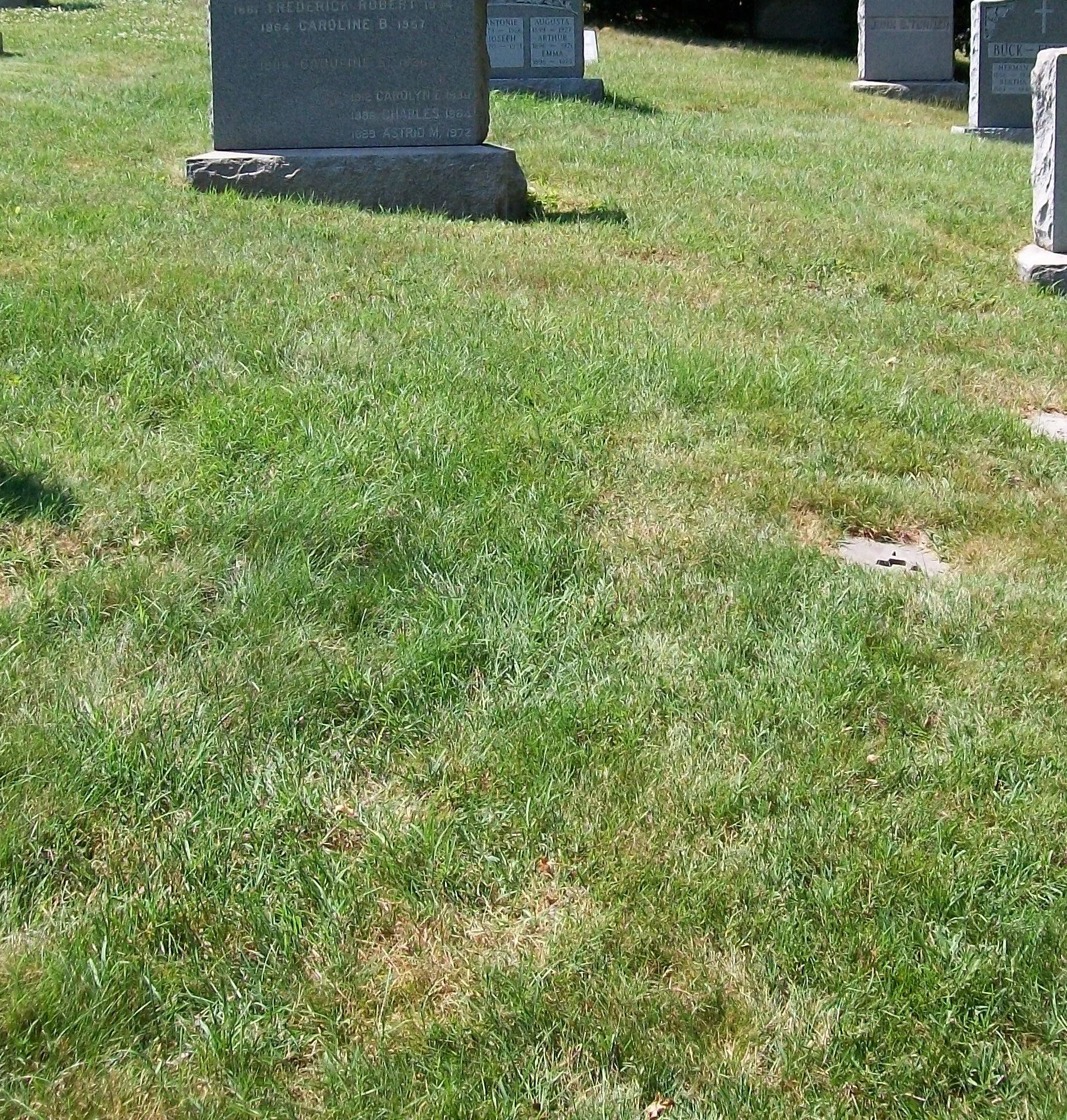
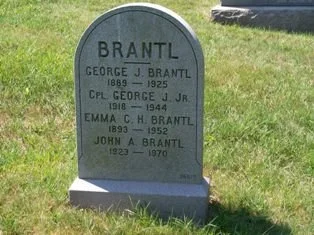
Ok, now the really final piece...GO THERE IF YOU CAN! Nothing beats going to the cemetery to see if there is a headstone and what is on that headstone. It can list other family members buried in the plot; it can list birth dates; it can list places of birth; it can list just about anything. Just a little suggestion when you do go to visit the cemetery – take a look at the headstones nearby the one that belongs to your family and take their photos too. You just might find more family! I did not do that when I went to Greenwood Cemetery in Brooklyn NY. I was looking for Anders Swanberg’s burial site, which I found with some work since there was no headstone. I did take a photo of the grass (just my need to document no headstone!), but not of the ones around it. A few months later, I broke through a small brick wall and tracked down another line of the Swanberg line. Guess where they were buried?! Yup, the headstone was right next to my plot of grass for Anders Swanberg! I could have saved myself the trip had I taken some photos of the neighboring headstones when I was there for Anders.